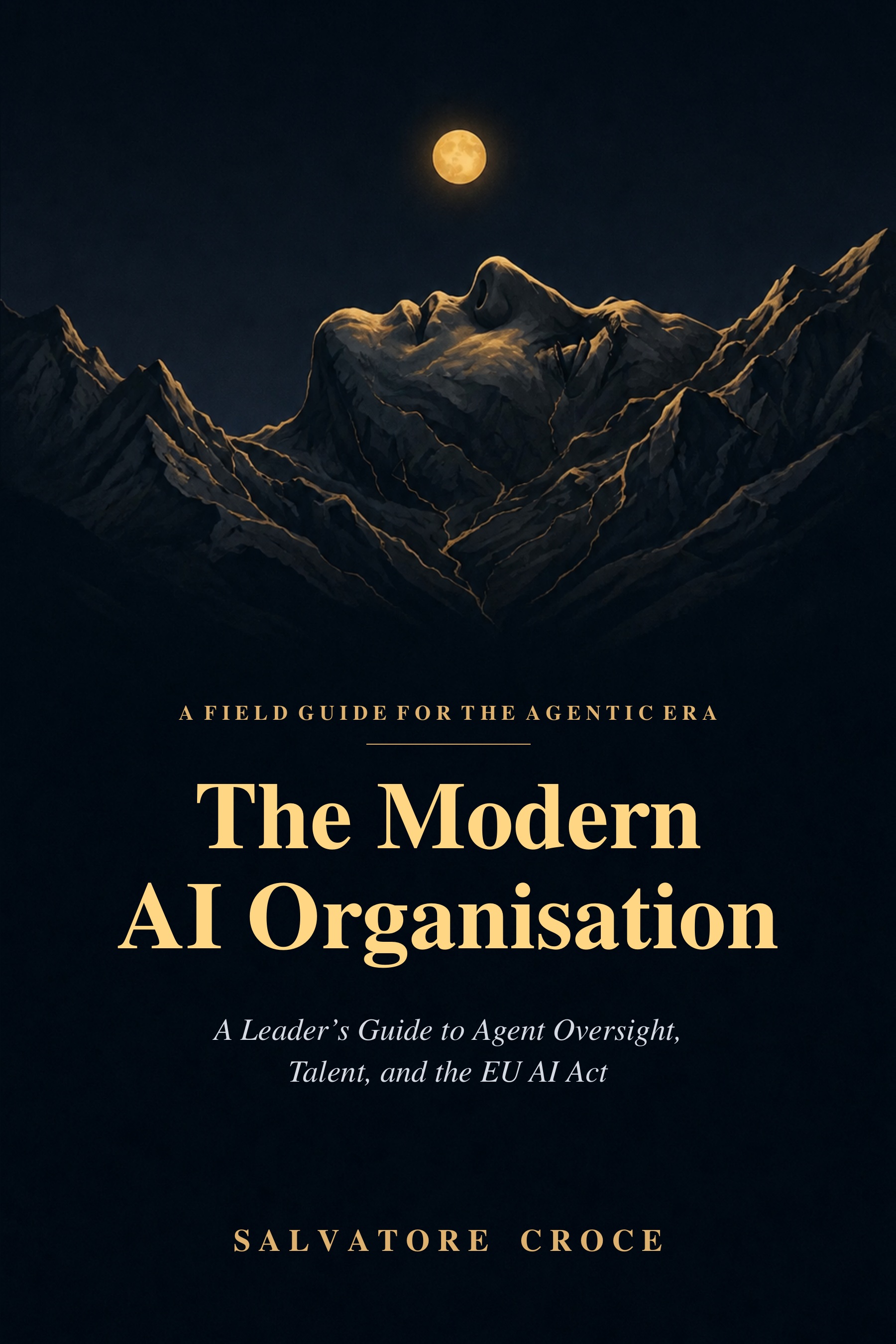
The Modern AI Organisation
A leader's guide to agent oversight, talent, and the EU AI Act.
Theoretical physics → AI governance
“The hard part of AI is almost never the model. It is the organisation — how work is designed, who does it, how trust is built, and how the whole apparatus is governed so it can scale without breaking.”
Why this book
2026 produced the first systematic measurement of how firms built around AI are actually organised. The result is not what almost any corporate AI programme is achieving.
Equipping people with AI assistants changes very little about how an organisation is shaped. Redesigning what the organisation delivers — moving the work inside the product rather than inside the process — changes almost everything. The book follows that distinction from its first page: through the work chart in place of the org chart, the M-shaped professional in place of the flat generalist, supervision "above the loop", and governance designed as a lever rather than a brake.
The Kim and Koning (2026) study quantifies it: firms that embed AI in the product have a headcount one-eighth smaller and a hierarchy one-fifth flatter than comparable firms in the same industry and founding cohort — even after controlling for how intensively employees use AI internally. It is a working paper not yet peer-reviewed, but the direction is clear.
Sources: BCG/Harvard data, a peer-reviewed study on AI use in tasks beyond the technological frontier; the book's original acceptance-sampling framework (Appendix B). The Kim & Koning (2026) study, cited above, is a working paper not yet peer-reviewed.
Where does your organisation stand?
A two-question extract from the book's AI-Readiness diagnostic (Appendix A), designed for the expert group of Federmanager. It is not a test with a right answer — it is a mirror.
1 · How far has your organisation gone in adopting AI?
4 · How is the use of AI overseen?
Answer both questions to see where the matrix places you.
Inside the book
260 pages, three parts, eight chapters. Every chapter closes with "What to do on Monday".
Opening
Before You Begin: Where Is Your Organisation?
The full four-question diagnostic — the extended version of the interactive tool above.
Introduction: AI Is Everywhere, Value Is Not (Yet)
The gap between investment and impact, and the process-versus-product distinction that explains why.
Part I — The Shape of the Firm
From Org Chart to Work Chart
Point solutions plateau fast; the value shows up in workflows redesigned around an outcome.
Hills with Canyons
Why the agentic era rewards the M-shaped professional over the flat generalist — breadth to orchestrate, depth to catch failure.
Above the Loop
Where human oversight actually holds under agentic AI, and why oversight capacity is the real ceiling on scale.
Part II — The People
Reskilling and Compression
AI narrows the gap between novice and expert — which quietly breaks the apprenticeship pipeline that grows the next expert.
Trust as Infrastructure
Why trust between people, teams, and agents has become a throughput problem — and how to engineer it deliberately.
Part III — The Guardrails
Governance as an Operating System
Five pillars for governing agents that increasingly supervise other agents — designed as an enabler, not a brake.
Privacy and the Walled Garden
Why your own proprietary data corpus is the real competitive moat, and how privacy-by-design protects it.
The AI Act and the Regulated Firm
Risk tiers, provider-versus-deployer, and the classification judgement calls that decide what your organisation actually has to do.
Closing
Conclusion: Think Boldly, Move Fast, Go Deep
The book's argument compressed into one causal chain, and where a leader actually starts on Monday.
Appendix A · The AI-Readiness Diagnostic
The full four-question instrument behind the interactive tool above, with a reading guide and action plans.
Appendix B · Master Agent Management
Acceptance-sampling statistics — borrowed from quality control — for deciding how much evidence is enough before trusting a fleet of agents.
Take it with you
260 pages. Independently published on Amazon KDP.